


How We Choose the Right Softener for You










Section 1 – Why Completely Independent Advice Changes Everything
When I first bought Hydroworks, I quickly became uncomfortable with something that was completely normal within our industry.
Like most dealers, we had agreements with several major manufacturers. But I began to realise that those relationships could influence what we recommended to customers.
If we were behind on a sales target, there was pressure to sell more of that manufacturer’s products. If we didn’t sell enough, prices could increase, access to products or spare parts could become more difficult, and invitations to dealer meetings could disappear.
I didn’t like it.
I wanted to be able to walk into a customer’s home, look properly at their water, their plumbing, their budget and what they actually wanted to achieve — and then recommend the solution I genuinely believed was right for them.
So I made the decision to step away from those agreements and make Hydroworks truly independent.
It wasn’t an easy decision, and it certainly came at a cost. Some manufacturers stopped supplying us altogether, and for several years there were products we simply couldn’t offer.
But I believed independence mattered more.
Today, Hydroworks has grown into one of the UK’s larger independent water treatment specialists, and we once again have access to products from across the industry. The difference is that we choose what we recommend.
That is incredibly important to me.
When I visit your home, I’m not thinking about a sales target or which manufacturer I need to keep happy. I’m looking at what you need and which solution I believe is genuinely the right one for you.
Section 2 – It Starts With Understanding You
Before I recommend anything, I need to properly understand your situation. Not just your water, but your home, your family, how you live and what you are actually hoping to achieve.
There is no point in me telling you which water softener I think is best until I understand what "best" actually means for you.
So these are some of the questions I’ll usually ask.
What made you start thinking about a water softener?
It might be the limescale on your taps and shower screens. Perhaps you’re fed up with cleaning, worried about your boiler or appliances, or someone you know has a softener and you’ve noticed the difference.
Whatever brought you here matters, because it helps me understand what you most want to improve.
Have you had a water softener before?
If you have, I’ll want to know what you liked about it — and what you didn’t.
And if you’ve already done some research, tell me what you’ve discovered. There is an enormous amount of information out there, some excellent and some rather less so, and it helps me to understand what you already know and what questions you still have.
How many people live in your home?
This is important. The number of people using water in the home affects the size and type of softener I might recommend, how frequently it needs to regenerate and how it will cope with your real everyday water use.
I’m interested in how the machine will actually perform in your home, not simply what a specification sheet tells me it can do.
What sort of hot water system do you have?
A combi boiler, an unvented cylinder and a traditional loft-tank system all behave differently.
Understanding your plumbing and hot water system helps me recommend not only the right softener, but also the right way to install it.
Does anyone in the home suffer from dry skin or conditions such as eczema?
I ask because this may be particularly important to you.
If skin comfort is one of the reasons you’re considering softened water, I want to understand that from the beginning and take it into account when we discuss the options available.
Have you thought about your budget?
I would much rather ask this openly than dance around the subject.
It isn’t about trying to sell you the most expensive machine you can afford. It simply helps me understand what is realistic for you and where I should focus my advice.
There are many different water softeners available at very different prices. My job is to help you understand where the genuine differences are and which ones actually matter in your home.
And finally, how hard is your water?
Now we start looking at the water itself.
Water hardness varies enormously from one area to another and, sometimes, even between nearby towns. Understanding your actual water hardness helps us calculate what the softener will need to do and how efficiently different machines will cope with it.
Section 3 – The Holy Grail: Completely Soft Water, Consistently
This is probably one of the most important things I explain to customers, because it is something very few people realise — even within my own sector.
Most of us would naturally assume that a water softener either produces soft water or it doesn’t.
Unfortunately, it isn’t quite that simple.
A water softener can be working perfectly well for much of the time, but still allow a degree of hardness through at certain points in its cycle. The result can be water that is technically described as “soft”, but still contains enough residual hardness to leave visible deposits behind.
And therein lies a very big difference.
The Shower Screen That Taught Me a Lesson
Some years ago, shortly after I bought the business, I was delivering salt to one of our customers in Tonbridge, Mr Redman.
While I was there, he told me that he wasn’t particularly impressed with water softeners. He simply didn’t think they were as good as people claimed.
Naturally, I wanted to understand why.
He took me upstairs to his wife’s bathroom and showed me the glass shower screen and controls. I ran my hand down the inside of the glass and my fingers came away covered in a white, chalky residue.
Here is what I saw:

That was an instant giveaway to me.
If the softener had not been working at all, the glass would have felt very different and my hands would have come away clean of chalky residue. What I was seeing suggested something more interesting: the softener was clearly reducing the water's hardness, but it wasn’t removing it completely or consistently enough to prevent deposits from building up.
This is something that frustrates me about our industry. Customers are often simply told that their water is “soft” and their machine is “working”, without anyone really explaining that there can be quite a difference between water that falls within a broadly accepted softened range and water that is completely soft.
Once I had seen what was happening in Mr Redman’s home, I wanted to show him the evidence so that he could have confidence in the advice I was giving him.
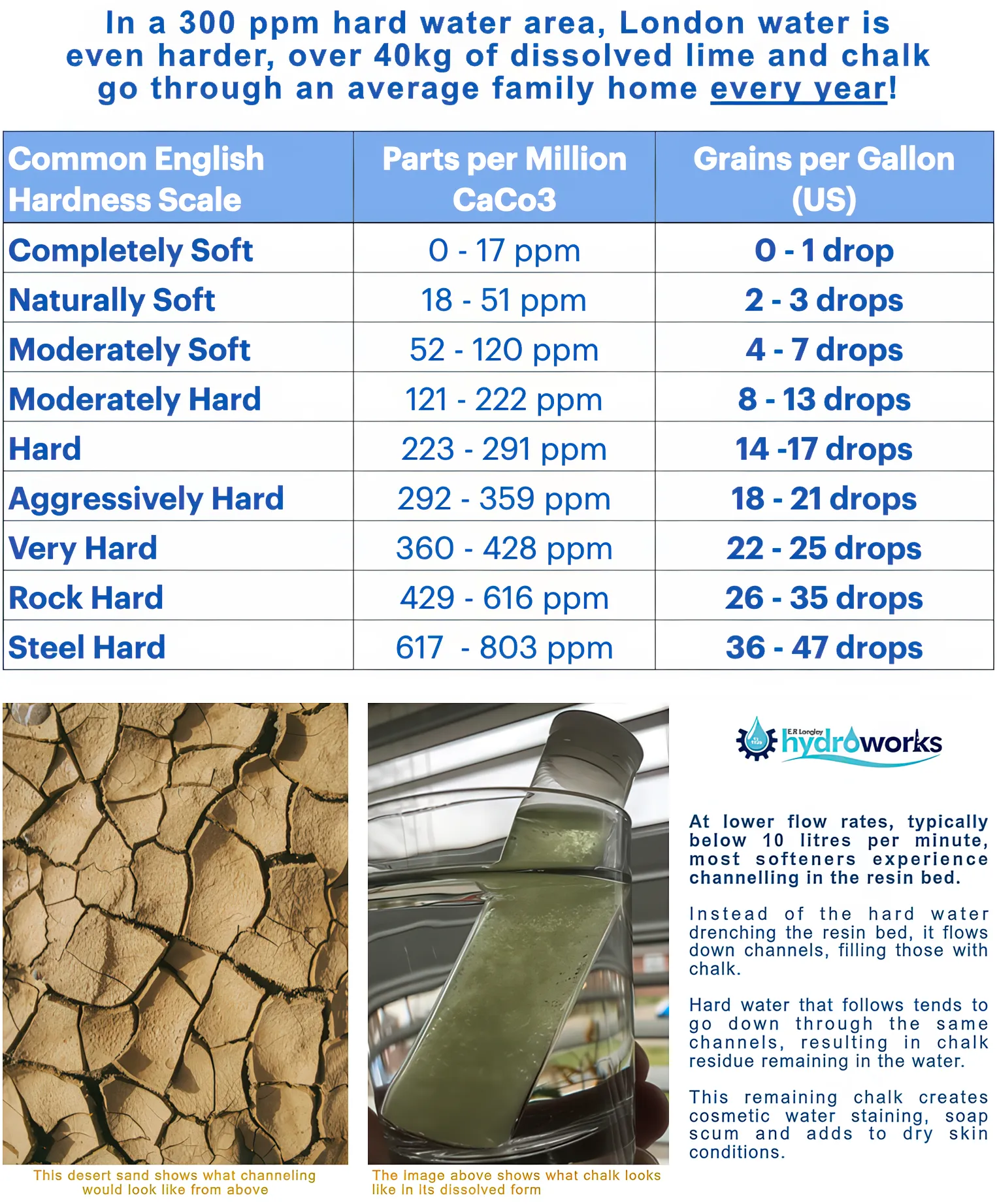
So we tested the water properly. Refer to the table above to see how this played out...
The cold water at the kitchen sink tested '0 drops '- completely soft. The softener had recently regenerated, so the water it was producing at that moment was exactly as it should be.
But when we tested the hot water, the result was '11 drops' of hardness - moderately hard water.
Then we tested the water coming through the shower itself, where the hot and cold water mixed together.
That measured '5 drops' - moderately soft water.
Now, many professionals within our industry would describe anything from 0 to 7 drops as being within a softened water range and would therefore say that the softener was working within acceptable parameters.
And, in fairness, it was working.
The local incoming water hardness was '18 drops' - Aggressively Hard Water, so the softener was removing a considerable amount of hardness from the water.
But Mr Redman’s shower screen told a rather different story.
That experience taught me something that has influenced the way I have looked at water softeners ever since:
For me, the Holy Grail isn’t simply producing water that can be described as soft. It consistently produces completely soft water.
Why the Hot and Cold Water Can Tell Different Stories
Mr Redman’s home had stored hot water, and this gave us a particularly useful insight into what had been happening.
With a hot water cylinder or traditional loft-tank system, the water coming from the hot tap has accumulated over time. In simple terms, it can contain water produced by the softener today, yesterday and perhaps even the day before.
That means the hot water can give us something of a history of the softener’s recent performance — and we would typically say that, depending on the household and the size of the storage system, it may reflect up to eight weeks of water use.
If the softener has allowed some hardness through at any point, that harder water can mix with the completely softened water already being stored.
A combination boiler is different because it heats water as you use it. A hardness test therefore, tells us how the softener is performing at that particular moment.
If you test the water immediately after regeneration, it may be completely soft. But if you test it at another point in the softener’s cycle, you may get a different result.
So, for me, the most important question isn’t simply whether a water softener can produce soft water.
It is:
"Can it produce completely soft water — and can it do so all of the time?"
That is the distinction I believe really matters.
What Are We Actually Aiming For?
Some within our industry are comfortable describing water with a residual hardness reading as soft.
My own aim is different.
I want to get as close to completely soft water as we reasonably can, and I want the softener to maintain that quality as consistently as possible.
Not just immediately after it regenerates.
Not just at the moment we happen to test it.
But throughout the way you actually use water in your home.
That, for me, is the Holy Grail of softened water.
This distinction can be particularly important where skin comfort is one of the reasons for considering softened water. It also matters in areas where the incoming water is less hard, because a softener that allows hardness to break through may be achieving far less than the headline figures suggest.
And it is one of the most important things I consider when deciding which water softener I am prepared to recommend.
Section 4 – Why Flow Rate Matters More Than You Might Think
So, if the Holy Grail is completely soft water, consistently, the next question is an obvious one:
Why are some water softeners better at achieving this than others?
One of the answers lies in something most customers would probably never think to ask about: flow rate. Not within the home, which many customers ask about, but the impact of low flow on the softener.
Put simply, flow rate is the speed at which water passes through the softener.
Now, this is where things get interesting.
The way we actually use water in our homes varies enormously.
Sometimes we use a lot of water very quickly … perhaps when filling a bath, running multiple showers, or using several outlets at the same time.
But much of the time, our water use is far gentler. We wash our hands, rinse a cup, clean our teeth, fill a kettle or run a single appliance.
In addition, many modern homes with combination boilers or unvented cylinders are effectively supplied from a single incoming cold water main. Open several taps at once, and you will often notice the flow reduces elsewhere
So, despite the enormous maximum flow rates you sometimes see advertised, the reality is that a great deal of everyday water use happens at much lower flow rates.
And here is the problem.
A good water softener needs to perform properly at both high and low flow rates. Very few do both equally well.
That matters enormously to me.
What Is Actually Happening Inside the Softener?
Inside a water softener is a bed containing millions of tiny resin beads. As hard water passes through them, the calcium and magnesium minerals responsible for water hardness are removed.
That sounds wonderfully simple.
But the water needs proper contact with the resin for that process to work effectively.
The design of the vessel, the amount of resin, the way the water is distributed through it, and the speed at which the water is travelling can all influence the result.
This is one of the reasons I am very cautious about judging a water softener solely by the largest flow-rate number printed on its specification sheet.
A machine might be capable of supplying an impressive number of litres per minute.
That’s useful information, of course.
But it doesn’t answer the question I’m most interested in:
"What is the quality of the water coming out of the softener across the full range of flow rates we actually use in our homes?"
For me, that is far more important.
The Problem at Lower Flow Rates
This is where we come back to normal, everyday water use.
- A washing machine or dishwasher drawing water at about 1.5-3 LPM, depending on the model
- An electric or combination boiler shower might flow at 5-7LPM
- Washing up typically uses 1-2LPM
- Filling the kettle at perhaps 1/2LPM
These are perfectly normal things we do every day, but they can create much lower flow rates than the impressive headline figures quoted in a brochure.
There is also another consideration.
Many water softeners use a meter to measure how much water has passed through the machine. The softener then uses that information to calculate when it needs to regenerate.
But every meter has an operating range, and most struggle to measure flow rates effectively below 10 L/min.
At very low flows, some metering systems may not register water use accurately. That matters because water can potentially pass through the softener without being fully accounted for in its capacity calculations.
This is why I look beyond the headline numbers.
I want to understand not only how much water a softener can deliver when pushed to maximum demand, but how the entire system behaves during the ordinary, everyday use that makes up most of our lives.
Sometimes the Small Print Is More Interesting Than the Brochure
Over the years, I have spent a great deal of time reading manufacturers’ technical manuals.
I know. I need to get out more.
But normally, buried in all that technical information, you find something very interesting.
Here is an example from one manufacturer’s own documentation, which includes a warning about performance below a particular flow rate.

I find information like this fascinating.
Not because I want to criticise a particular manufacturer — I don’t. Every water softener has strengths, weaknesses and engineering compromises.
But it demonstrates why I believe we have to look beyond the headline claims.
The question isn’t simply "How many litres per minute can this softener deliver?"
For me, the more important question is:
"Can it deliver completely soft water, consistently, in the way this particular household will actually use water?"
That is a very different test.
And it is one of the reasons I will never recommend a water softener from a specification sheet alone.
And this brings me to the question I’m most often asked:
"With so many water softeners available, how do I actually decide which one is right for you?"
Section 5 – The Hydroworks Litmus Test: How We Choose Our Products
Over the years, I’ve developed my own way of looking at them. I call it my Litmus Test.
It isn’t based on which manufacturer offers us the best margin, which machine has the cleverest marketing or which specification sheet has the biggest numbers.
It is based on the things I believe genuinely matter when a water softener is installed in a real home and used by a real family, every day.
So, let me show you exactly what I look for.
✅ Litmus Test 1 – Reliability: Built to Last, Not Just to Sell
A water softener isn’t something most people want to think about very often.
You have it installed, and you expect it to simply get on with the job — quietly, reliably and for many years.
So, for me, reliability isn’t a nice-to-have. It is absolutely fundamental.
What makes a reliable softener?
- Proven longevity – a product should last decades, not just years.
- High-quality internal components – not just a fancy exterior.
- Minimal failure rates – we don’t deal with manufacturers that cut corners.
I also look at how extensively it has been tested and, most importantly, what actually happens when thousands of these machines are installed in real homes.
The Truth About Failure Rates
Failure rates vary enormously across our industry, far more than most customers would ever guess from a brochure.
The reality is that this information is rarely made public. Manufacturers aren't required to publish their failure rates, and most understandably prefer not to draw attention to a number that doesn't flatter them. So customers are left to take reliability largely on trust — usually based on how a product looks, how confidently it's marketed, or how long a warranty sounds.
That's exactly why I don't rely on marketing claims when I assess reliability. I look at how long a product has genuinely been proven in UK homes, how it's actually built, and — where I can get it — what a manufacturer will tell me honestly about how their product performs over time.
Common water softener failure causes
- Poor build quality – cheap components that break easily.
- Electronic faults – especially in budget models.
- Resin failure due to chlorine contamination – one of the biggest failure causes worldwide.
- Incompatibility with UK plumbing – yes, even some UK-sold softeners aren’t appropriately designed for UK homes!
Bottom line? If a softener isn’t built for long-term performance, it doesn’t make our list!
A Management Meeting I Have Never Forgotten
I was fortunate enough to see just how seriously one manufacturer approached this from the inside.
Before buying Hydroworks, I spent some time as Dealer Manager at Harvey Water Softeners, where I was responsible for supporting and significantly growing sales across its dealer network.
The role meant that I sat on the management team and worked closely with the Managing Director, Chairman and Technical Director. I was, in many ways, the link between what dealers and their customers were experiencing in the real world and the decisions being made within the business.
I remember one management meeting particularly clearly.
I was sitting next to Harvey’s son, Casey, when Debbie, the Service Manager, who sat opposite Casey, presented the latest product failure figures.
The figures weren’t good.
Harvey became increasingly frustrated as he listened and eventually asked a very simple question:
"Why can’t we make a product that works every single time?"
Casey turned to his father and suggested that they might have the wrong Technical Director.
Harvey immediately told him, "Casey, don't say that in front of the staff!"
I remember the exchange because, underneath the slightly awkward moment, I could see that Harvey was thinking seriously about what Casey had said.
Two months later, at another management meeting, Harvey told us that the existing Technical Director was going to take early retirement, and that he had spent the previous weeks looking for someone with the right skills to join us.
He had found someone!
His name was Martin, and he was coming in to meet us after the meeting.
Martin’s proposition was ambitious: "Give me an unlimited budget and twelve months, and I will reduce the product failure rate to under 1%".
Harvey, thinking the claim was incredibly bold, told him that if he achieved it, he would make him Managing Director.
Casey rather reasonably pointed out that he was already the Managing Director.
Harvey’s response was essentially that if Martin could achieve a failure rate below 1%, then perhaps Martin was the right person to lead the company.
And guess what... he did it.
Within 12 months, Martin had achieved the target and went on to become a very successful Managing Director.
Why That Story Matters to Me
I tell you this story because I was there.
I saw a company presented with an uncomfortable problem and watched what it did next.
It didn’t accept the failure rate as simply being part of manufacturing. It challenged itself, changed the way it worked and invested in making the product more reliable.
That experience has stayed with me.
A good warranty can help when something goes wrong. But I’d much rather recommend a product that is unlikely to need it.
✅ Litmus Test 2 – Running Costs: What’s the Real Price Over Time?
This is such a massive consideration, so it was hard not to make this number 1 on the Litmus Test.
The purchase price of a water softener is only part of what it will actually cost you.
A softener works quietly in the background every day, and depending on the quality of the softener, that might be a few years, or if you choose well, it might even be for decades. During that time, it will use salt and water, it may require some or regular servicing and repairs (depending on the model), and eventually it will need replacing.
So when I assess a water softener, I look beyond the price on the quotation and ask a much more important question:
“What is this machine really going to cost its owner over its lifetime?”
Salt and Water — The Costs That Keep Adding Up
Every water softener uses salt and water when it regenerates, cleaning and recharging the resin so that it can continue softening the water.
But the difference in efficiency between machines can be enormous.
Some softeners use over 100L of water & 1.3kg of salt per regeneration, while others use as little as 36L of water & 450g of salt.
- More efficient models = lower running costs over time.
Do you want to spend a lot or a little each year?
Annual Servicing — The Hidden Cost
This is an area where I think customers need to ask some careful questions.
You will often see phrases such as “no servicing required”, but it is worth looking more closely at what that actually means.
Some manufacturers have different servicing recommendations in different markets. Others recommend servicing every few years, while some machines are routinely sold with annual maintenance plans.
There is nothing inherently wrong with servicing a product when it genuinely needs attention. My concern is that when servicing becomes part of the commercial model, the customer becomes accustomed to paying every year, remains tied to a particular service provider, and may eventually be encouraged to replace the machine under the same ongoing plan.
Our Philosophy?
My own philosophy on this came directly from my mentor, Harvey Bowden.
When I worked for Harvey Softeners, I remember dealers complaining that Harvey said his machines did not require annual servicing. His reasoning stayed with me, and went something like this:
"If a business spends all its time going back to service the same 100 customers, ten years later it is still looking after the same 100 customers. Build a quality product that doesn’t need constant attention, and you can spend your time helping more people."
That was Harvey’s long-term thinking, and I have never forgotten it.
Length of Life – The Best Investment Lasts Decades
A water softener isn’t something you should have to replace every few years – it’s an investment that should last decades. But not all softeners are built for the long haul.
Typical Lifespans:
- Low-end models – 3 to 8 years (if you’re lucky)
- Mid-range models – 5 to 13 years (better, but still not ideal)
- High-quality softeners – 15 to 30+ years (and some go much longer!)
The longer a softener lasts, the better your return on investment. If you buy cheap, you’ll probably end up replacing it sooner, and in the long run, you’ll spend more.
✅ Litmus Test 3 – Softened Water Quality: The Holy Grail, Revisited
Earlier, I told you about Mr Redman’s shower screen and what it taught me about the difference between water that is technically described as "soft" and water that is genuinely, completely soft.
That experience stayed with me.
That idea — I call it the Holy Grail of softened water — is really what this third test is about. Everything else in my Litmus Test criteria matters, but this is the one that decides whether a softener is actually doing the one job it exists to do.
The same applies if you have a boiling water tap that doesn’t supply boiling water at 100°C, then you won't get the very best cup of tea.
If you have a water softener that can only soften the water within the range of soft, and therefore still leave chalk in the water, then softened water is not going to be as pleasurable to bathe in, and it's going to leave cosmetic water staining on fixtures and fittings as you'll see in the shower photographs a little bit further down.
More importantly, if you have dry skin conditions in your family, they won't be helped if there is still chalk in the water that blocks the pores. Hard water is even linked to acne because, once again, dissolved chalk blocks the pores of the skin!
Single Cylinder Softeners vs Twin Cylinder Softeners
Single-cylinder water softener

Not all softeners are the same. A single-cylinder softener can only do one thing at a time — either soften the water or regenerate its resin. While it regenerates, it’s supplying hard water to the house.
Most (though not all) single-cylinder models also struggle to accurately measure flow rates below 10 litres per minute — yet the majority of domestic water use happens at these lower flow rates.
Some manufacturers even build to the German DIN standard, which deliberately leaves hardness in the water supply. That may suit German homes (where there’s no choice), but it’s far from ideal for British homes, which can have completely soft water.
When a single-cylinder softener is installed in the wrong type of home, the result is often cosmetic water marks and staining on taps and shower screens, plus “blended” water with 50–120 ppm of hardness still remaining.
Twin-cylinder water softener
A twin-cylinder water softener delivers softened water all the time — even while one cylinder is regenerating. But not all twin-cylinder designs perform equally well.
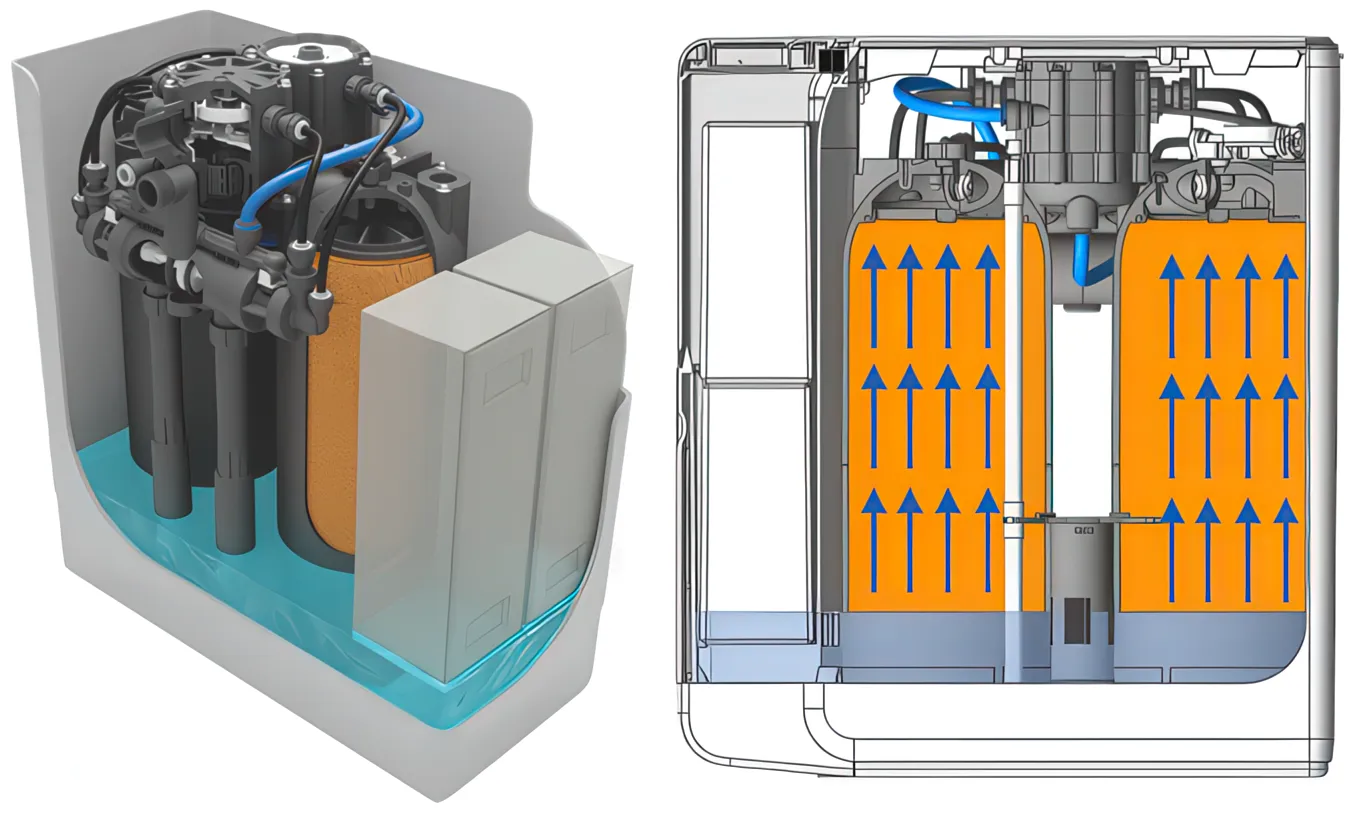
Some models, such as the American Kinetico, operate on a “flip-flop” system where only one cylinder works at a time. This forces customers to choose between a unit with high flow rates but higher running costs, or one with better efficiency but reduced flow rates.
By contrast, the British-made Harvey Minimax uses both cylinders simultaneously, guaranteeing consistently softer water without compromise. It combines high flow rates and high efficiency in one model, which is why it’s now the best-selling softener across the UK and Europe.
The Minimax also incorporates the same Elster water meter used by UK water authorities in their official household meters. Because water authorities don’t give water away, these meters are designed to measure virtually every drop with exceptional accuracy — and that’s the precision built into your Minimax.
How is the regeneration frequency determined?
Timer Controlled
Almost all single-cylinder softeners have a time clock override, set to a maximum of 4 days. These supersede any meter calculations. Some softeners don't have a meter and are time-clock controlled only.
Timer-controlled softeners regenerate at the same time every day whether, they need to or not. This wastes salt and water, makes the unit work unnecessarily hard, and shortens its lifespan.

Even many metered, single-cylinder softeners still have an in-built manufacturer pre-set to regenerate every three or four days. This is meant to “refresh” the resin bed and prevent bacterial build-up — but it’s really a workaround for machines that struggle to measure flow rates accurately below 10 litres per minute.
The result: higher running costs, more maintenance, and a much shorter service life than a properly metered, demand-driven softener.
Turbine Meter

Almost all metered water softeners use a form of meter like this.
Found in many single-cylinder softeners and even some twin-cylinder models such as Kinetico, the traditional “aeroplane propeller” style turbine meter is prone to letting hard water slip through. This “slippage” creates trickle flow, leaving hardness in the water and causing cosmetic staining on taps and sanitaryware.
For example, a softener might be designed to regenerate after 500 litres of softened water. But at lower flow rates, the turbine meter may under-record usage and only trigger regeneration after 600–700 litres, allowing hard water to pass through long before the unit resets itself. This creates blended water in a stored water home or hard water in a combination boiler home.
Within the industry, the inaccuracy of turbine meters is well recognised. Best practice often means fitting additional treatment solutions in the home — particularly on loft-tank or gravity-fed systems — or increasing the frequency of regeneration by adjusting the time clock or hardness setting.

Elster Displacement Meter

The most advanced, totally accurate meter — even used by the UK water authorities.
In my professional experience, the better the softener, the better the meter.
Within the UK market, British manufacturer Harvey has designed its softeners to use the very same Elster water meter (sometimes called a Kent meter) that water authorities fit to household supplies. These meters are renowned for their precision: if you have a leak, your water board will bill you for every drop — because their meters measure every drop.
The same level of accuracy is built into the Harvey Minimax softeners. They record virtually every drop of water used in your home — even a slow dripping tap — regardless of your plumbing layout or water system. This precision allows the softener to deliver incredibly soft water all the time.
As a result, Harveys is the only manufacturer in the domestic sector to guarantee completely soft water at all times — to a maximum of just one drop of hardness. By comparison, most other manufacturers class anything up to seven drops as “soft” (with many traditional softeners operating at 5–8 drops), which is unfortunately still enough to leave significant cosmetic water staining from remaining chalk and hardness in the mains supply.

Section 6 – Rinse & Repeat Trap: When Cheaper Softeners Cost You More
In recent years, the marketing machines behind cheaper Chinese water softeners have been in full force – often appearing in print media like the Daily Mail. Companies like EWT and Water2Buy built their success on selling lower-cost softeners wrapped in well-branded subscription plans for servicing and salt.
At first glance, it all seemed convenient and affordable. But for those who took the plunge, the writing was on the wall long before disaster struck. Over time, servicing became harder to access, spare parts became unavailable, and eventually, both businesses shut down. Customers with “guarantees” found out the hard way that a guarantee is only as good as the company standing behind it.
But here’s the real issue: This isn’t new. We’ve seen this happen in other industries—companies launch with cheap, attractive products, scale fast, and then collapse under the weight of poor quality and bad aftercare. Then, like clockwork, they reappear under a different name, doing the exact same thing all over again.
The phrase “rinse and repeat” comes to mind – except in this case, the only ones getting rinsed are the customers who regrettably trusted them.
The Three Main Types of Water Softeners Explained
There are three main categories of softeners, and knowing the difference can save you from costly mistakes:
1️⃣ Budget Models (3-8 Years Lifespan) – Cheaper upfront, but often built with plastic valves and no spare parts available. Always heavy on salt and water. Once it fails, it’s landfill.
2️⃣ Plumber/Builder Grade Models (5-13 Years Lifespan) – Reliable for a while, but often designed to be disposable. Repairs? Not always an option, and often only available from the manufacturer at a premium cost. Normally heavy on salt and water.
3️⃣ High-Quality Consumer Models (15-30+ Years Lifespan) – A long-term investment. Designed to be serviced, repaired, and to last decades when properly maintained.
Moral of the story? If you buy cheap, unfortunately you’ll probably buy at least twice and spend more than you intend on capital cost and definitely on running cost!
Section 7 – Do you want to use tablet salt or block salt?
Before we talk which salt, we must talk the quality of salt.
NEVER use sea salt or solar-evaporated salt in a water softener – it will permanently damage your softener.
You can read more about why I say that in Choosing the Right Salt Type for Your Softener.
Block Salt

Block salt softeners aren't suitable for every home, but for those where they are, you will find the salt easy to handle and convenient.
Block Salt creates a very pure brine solution – this typically means the softener requires less servicing and less ongoing maintenance.
Block salt is typically a little more expensive than tablet salt, which is countered by the savings made because these machines need less servicing.
Tablet Salt
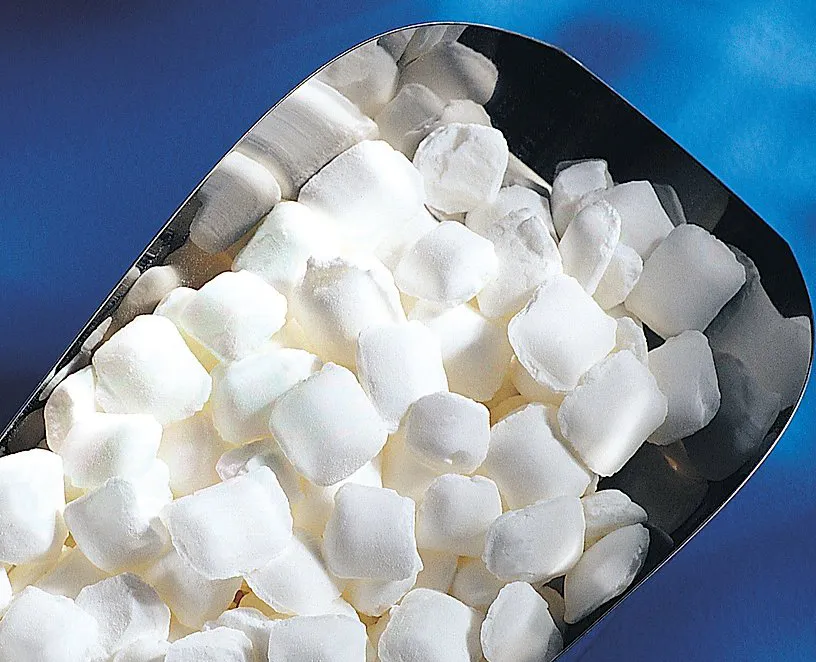
Tablet salt is better for a water softener than the older granular salt and comes in either 25kg bags or easier-to-handle 10kg bags.
Most tablet salt softeners are wildly inefficient, so we select only those softeners that are the most reliable, the most efficient and have the best performances.


